



All Photos (0)
Key Documents
 SDS
SDS
 COO/COA
OMB077
FavoriteOmiFluo™ LD-VP 563/596
suitable for HPLC, ≥98%
Synonym(s): OmiFluo™ LD-VP Red
Sign In to View
Organizational & Contract Pricing
Select a Size
| Pack Size | SKU | Availability | Price | Quantity |
|---|---|---|---|---|
| 25mg | OMB077-25mg | In stock | Inquiry |
-
+
|
| 5mg | OMB077-5mg | In stock | $507.00 |
-
+
|
| 10mg | OMB077-10mg | In stock | $897.00 |
-
+
|
Product Information
General Properties
Other Properties
Description
Safety Information
General Properties
| Purity | 98% |
| Appearance | red solid / purple solid |
| Solubility | Good in DMF, DMSO, and chlorinated organic solvents. |
| Purity Testing Method | HPLC |
| Storage Conditions | at -20°C in the dark. |
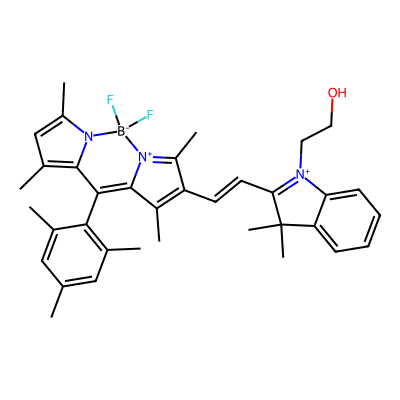
| SMILES string | C1=C(C)C(C2C3=C(C)C=C(C)N3[B-](F)(F)[N+]3=C(C)C(/C=C/C4C(C)(C)C5C=CC=CC=5[N+]=4CCO)=C(C)C=23)=C(C)C=C1C |
Other Properties
Spectral Properties
| Excitation Wavelength (λₑₓ) | 563 nm |
| Emission Wavelength (λₑₘ) | 596 nm |
| Molar Extinction Coefficient (ε) | 99600 L⋅mol⁻¹·cm⁻¹ |
DESCRIPTION
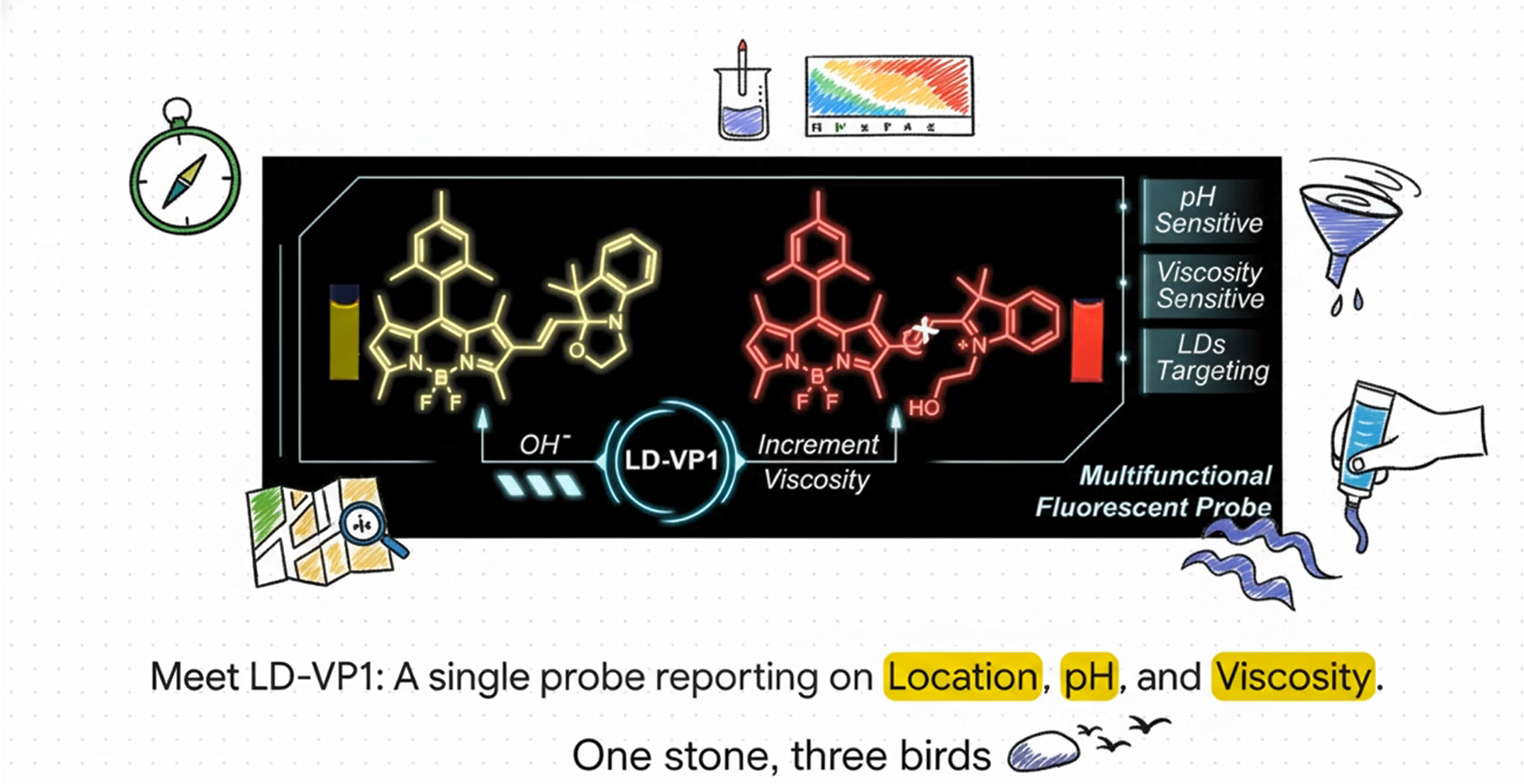
OmiFluo™ LD-VP 563/596 is a pioneering BODIPY-hemicyanine hybrid fluorescent probe designed for advanced organelle-specific imaging. It stands out as a "one stone, three birds" diagnostic tool, enabling simultaneous monitoring of multiple pathophysiological parameters.
• Multifunctional Detection: Precisely targets Lipid Droplets (LDs) while offering dual-responsiveness to microviscosity and pH fluctuations within the local environment.
• Unique Response Mechanism: In high-viscosity environments, it exhibits significantly enhanced red fluorescence (at ~610 nm) due to restricted molecular rotation; under alkaline conditions, it undergoes intramolecular cyclization, resulting in a blue-shifted yellow emission (at ~560 nm).
• Superior Optical Performance: Features exceptional photostability (outperforming Nile Red) and a high two-photon absorption cross-section (61 GM at 820 nm), making it ideal for high-resolution, deep-tissue imaging.• Pathological Diagnostic Potential: Successfully discriminates tumor cells from normal cells based on viscosity and tracks LD dynamics (count, size, and viscosity expansion) during atherosclerotic foam cell formation.
• High Precision: Boasts extreme lipophilicity (CLogP = 9.59) for spontaneous LD partitioning and a physiological-range pKa of 7.45
SAFETY INFORMATION
-
Symbol GHS
-
Hazard Code
H315,H319,H335
-
Risk Statements
-
Safety Statements
-
RIDADR
-
WGK Germany
3
-
RTECS
-
F
-
Hazard Class
-
Packing Group
-
HS Code
-
Toxicity
-
Autoignition Temperature
RELATED PRODUCTS
REFERENCES