



News
Choosing the right fluorescent dye for your experiment doesn’t have to feel complicated.
Jun 18, 2026
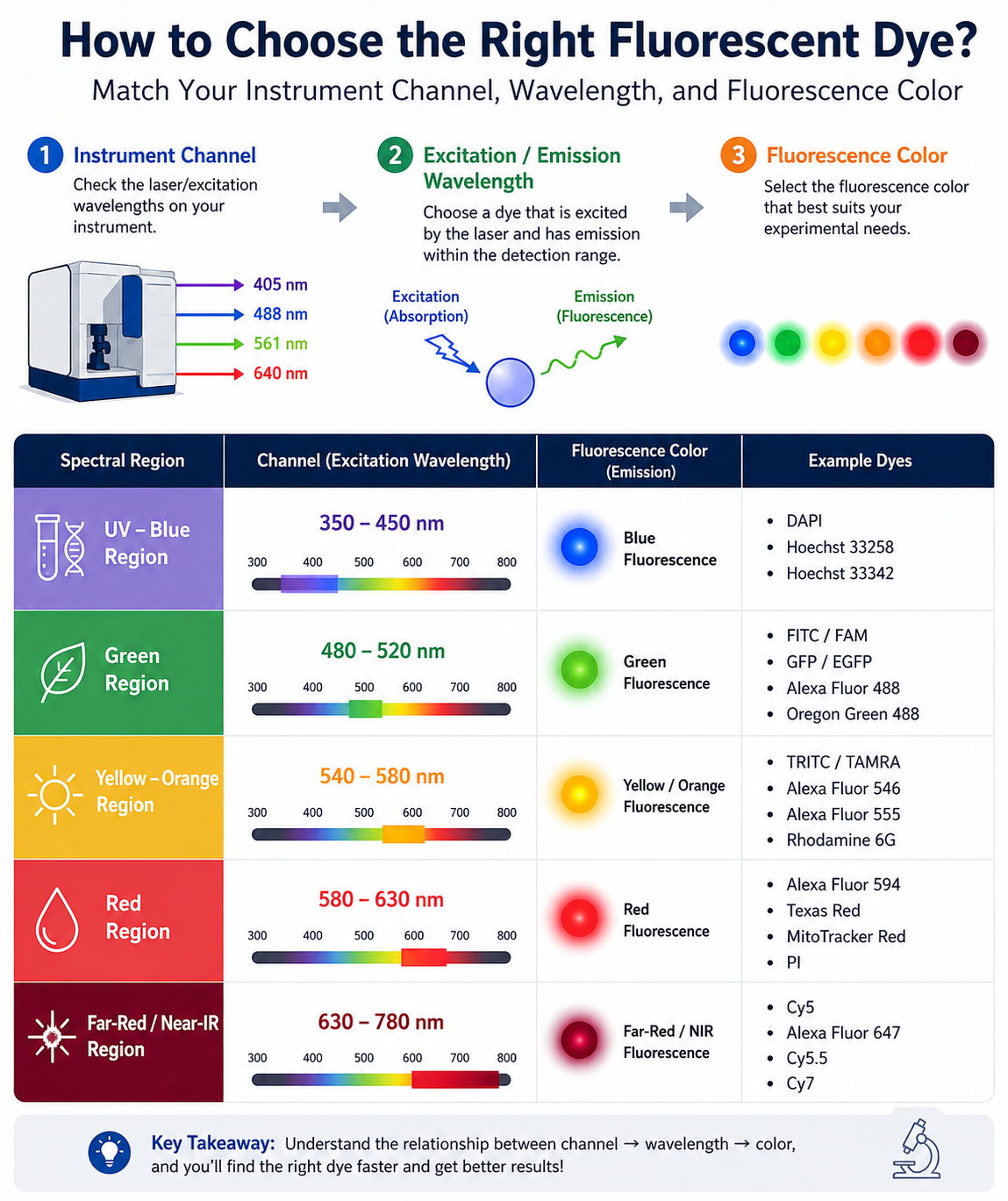
Many researchers run into the same questions:
🔹 “Which dye matches my instrument channel?”
🔹 “I need red or green fluorescence — what should I choose?”
🔹 “How do I avoid signal overlap and wasted experiments?”
The good news: selecting a fluorescent dye often comes down to just **3 key factors**:
✅ **Instrument channel** – What laser/excitation source does your instrument use? (405 nm, 488 nm, 561 nm, 640 nm, etc.)
✅ **Excitation/Emission wavelength** – The dye must be efficiently excited and detected within your instrument's range.
✅ **Fluorescence color** – The visible output that helps distinguish your targets.
The workflow is simple:
1️⃣ Confirm your instrument laser/channel
2️⃣ Match the dye excitation wavelength
3️⃣ Choose the fluorescence color you need
A quick guide:
🔵 **UV–Blue region (350–450 nm)**
Blue fluorescence
Examples: DAPI, Hoechst 33258, Hoechst 33342
🟢 **Green region (480–520 nm)**
Green fluorescence
Examples: FITC/FAM, GFP/EGFP, Alexa Fluor 488, Oregon Green 488
🟡 **Yellow–Orange region (540–580 nm)**
Yellow/Orange fluorescence
Examples: TRITC/TAMRA, Alexa Fluor 546, Alexa Fluor 555, Rhodamine 6G
🔴 **Red region (580–630 nm)**
Red fluorescence
Examples: Alexa Fluor 594, Texas Red, MitoTracker Red, PI
⚫ **Far-red/Near-IR region (630–780 nm)**
Far-red/NIR fluorescence
Examples: Cy5, Alexa Fluor 647, Cy5.5, Cy7
Understanding the relationship between **channel → wavelength → color** can save time, reduce troubleshooting, and improve experimental success.
What fluorescent dye do you find yourself using most often in your experiments?
Share:


