



News
Fluorescent Dyes: How They Really Emit Light
Jul 21, 2026
Fluorescent dyes work through a simple cycle:
Absorption → Relaxation → Emission
Absorption (Excitation):
Molecules absorb specific wavelengths and jump to an excited state.
Relaxation:
Part of the energy is lost as heat (vibrations), stabilizing the molecule.
Emission (Fluorescence):
Remaining energy is released as light, returning to ground state.
This cycle can repeat tens of thousands of times—unless the molecule is damaged (photobleaching).
🌈 Excitation vs Emission (Ex/Em)
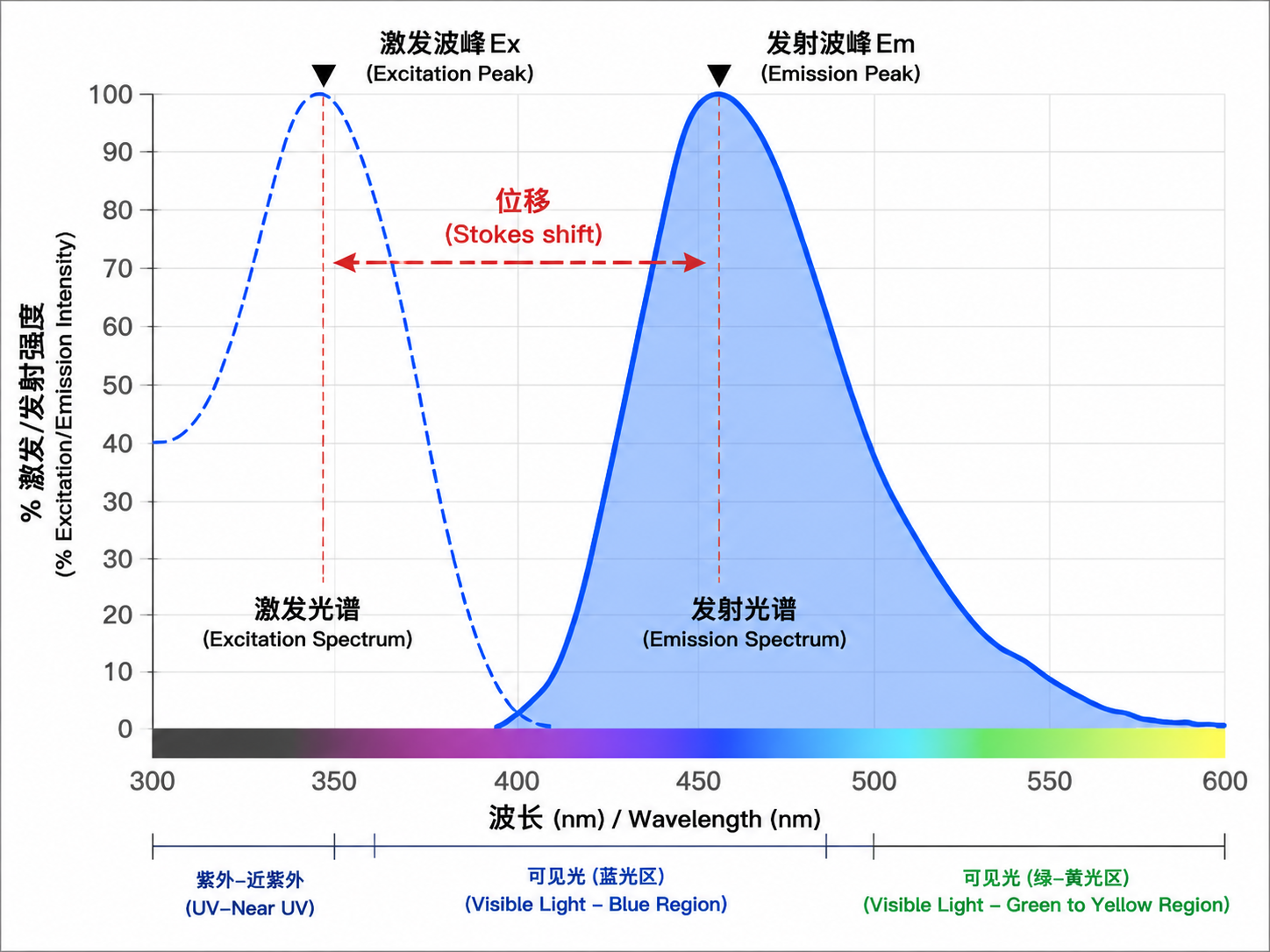
Each dye has two key peaks:
Ex (Excitation): best wavelength to excite fluorescence
Em (Emission): strongest emitted signal
Examples:
FITC: 494 / 520 nm
Cy3: 555 / 570 nm
Cy5: 646 / 662 nm
💡 Small shifts may occur depending on buffer conditions (PBS, etc.).
🌊 Stokes Shift (Why It Matters)
Stokes shift = gap between Ex and Em
Small (~10 nm): high overlap, more interference
Medium (20–30 nm): most common in bio imaging
Large (200+ nm): clean separation, low crosstalk
👉 Bigger shift = cleaner signal
⚙️ 3 Key Performance Factors
Brightness = ε × Φ
ε (extinction coefficient): how strongly it absorbs light
Φ (quantum yield): how efficiently it emits light
Example:
BODIPY: very bright (high Φ)
Cy3: lower efficiency
⚠️ Two Key Limitations
Quenching (reversible): too many dyes → signal drops
Photobleaching (irreversible): light damage → permanent loss of fluorescence
👉 Best practice: low light exposure + optimized labeling
🧪 Takeaway
Fluorescence is a balance of:
energy absorption, efficiency, and stability
Understanding Ex/Em, Stokes shift, and brightness is key to designing reliable imaging experiments.
Absorption → Relaxation → Emission
Absorption (Excitation):
Molecules absorb specific wavelengths and jump to an excited state.
Relaxation:
Part of the energy is lost as heat (vibrations), stabilizing the molecule.
Emission (Fluorescence):
Remaining energy is released as light, returning to ground state.
This cycle can repeat tens of thousands of times—unless the molecule is damaged (photobleaching).
🌈 Excitation vs Emission (Ex/Em)
Each dye has two key peaks:
Ex (Excitation): best wavelength to excite fluorescence
Em (Emission): strongest emitted signal
Examples:
FITC: 494 / 520 nm
Cy3: 555 / 570 nm
Cy5: 646 / 662 nm
💡 Small shifts may occur depending on buffer conditions (PBS, etc.).
🌊 Stokes Shift (Why It Matters)
Stokes shift = gap between Ex and Em
Small (~10 nm): high overlap, more interference
Medium (20–30 nm): most common in bio imaging
Large (200+ nm): clean separation, low crosstalk
👉 Bigger shift = cleaner signal
⚙️ 3 Key Performance Factors
Brightness = ε × Φ
ε (extinction coefficient): how strongly it absorbs light
Φ (quantum yield): how efficiently it emits light
Example:
BODIPY: very bright (high Φ)
Cy3: lower efficiency
⚠️ Two Key Limitations
Quenching (reversible): too many dyes → signal drops
Photobleaching (irreversible): light damage → permanent loss of fluorescence
👉 Best practice: low light exposure + optimized labeling
🧪 Takeaway
Fluorescence is a balance of:
energy absorption, efficiency, and stability
Understanding Ex/Em, Stokes shift, and brightness is key to designing reliable imaging experiments.
Share:


